Wrapped in Green : The Quiet Ritual of Endings
- Tanvi Gotmare
- Dec 15, 2025
- 3 min read

You are seated in a room full of people: relatives chattering, children running around, plates being moved, and a few guests idly seated. Then, a boy approaches, bearing a tray and offering paan, the infamous Betel leaf. As you look around, a woman takes a lush, heart-shaped green leaf and carefully spreads a mixture of slaked lime and gulkand (a rose-petal preserve) onto its glossy surface. She adds fragrant toppings: fennel seeds, coconut shavings, clove, cardamom, and areca nut, before meticulously wrapping the ingredients. She secures the final fold with a clove for the elders; the children, of course, demand a cherry on top. This much familiar delight often marks the end of an occasion. With the crowd beginning to murmur and final greetings exchanged, those who have taken the paan are signalling their goodbyes. This almost ceremonial ritual, consumed after any meal, spicy, tangy, filling, or light, is a refreshing closure. The sweet and silent betel leaf, served at the conclusion of many gatherings, doesn't make a loud gesture, but offers a mellow transition from one phase to the next.
Known by multiple names across India, vethalai in Tamil, tamalapaku in Telugu, vethila in Malayalam, vadele in Kannada, this simple, fragrant leaf carries centuries of cultural memory and symbolises the grace with which we acknowledge endings. Its preparation, especially in India, is an art. The leaf is coated with slaked lime and catechu, then layered with ingredients such as fennel, coconut, clove, and gulkand. Nothing is random; each component is deliberately chosen, combining to create a culinary journey, a miniature map of India assembled within a single wrap. Beyond its botanical or culinary importance, the Betel leaf holds a sacred role, particularly in the Southern states. When taken with areca nut and/or slaked lime, it constitutes "Tambulam", a ritual offering believed to bring good luck and strengthen social ties. According to texts such as the Skanda Purana, the betel leaf emerged from the churning of the universe and was bestowed upon humanity by the gods. It is a symbol of freshness, auspiciousness, and continuity. The glossy leaf's surface symbolises purity. At the same time, its apex symbolises direction and purpose, making it an indispensable part of celebrations and rituals, which are often considered incomplete without it.
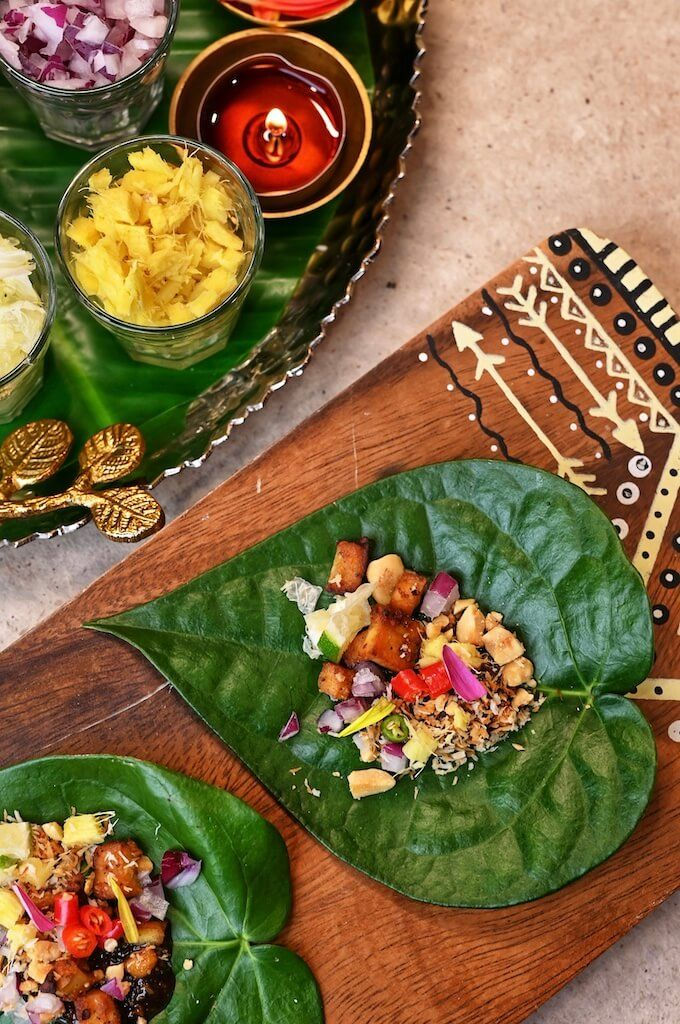
One cannot ignore its digestive benefits; the Sushruta Samhita advised chewing paan to aid digestion and clear the nasal passages. But its purpose is much grander. In Buddhism, Hinduism, and other Asian cultures, the betel leaf is an offering, a blessing, a gesture of respect, and a sign of approval. Historically, these betel quids, now endeared by old and young alike, were once admired by royalty, decorated, stored, and carried in elaborate tin boxes. Medieval travellers like Ibn Battuta and Marco Polo were struck by how every significant event in India, a palace banquet, a family gathering, a matrimonial pact concluded with a paan, signifying goodbye and amen. The ritual is one of emotional completeness.
The leaf offering itself is considered obligatory; nothing should be torn or left behind, as every part, even the stem, has significance. Like a story with a final line, a dish with a finishing flavour, the Betel leaf brings a celebration to a soft, mindful conclusion.

As the year ends, I find myself pondering this significance. The ritual of taking the paan, folding it, stuffing it with contrasting spices, and consuming it is a potent symbol of how endings can, in themselves, be robust and full of promise. This is the season when we metaphorically gather all our experiences of the past months, the spicy, the sweet, the bitter, and swathe them in our consciousness before letting them sink into our being. This tradition teaches us that closure need not be black-and-white, plaintive, or tragic. Closure can be a ritual of blessing and gratitude.
Just as the betel leaf helps in digesting a feast, this season brings us help in digesting the year as a whole, the experiences of learning, accomplishment, stumbling blocks, and surprise. Taking a moment to realise that we are, in fact, at a threshold, we pay respect to the act of letting something end. As the saying goes, "All is well that ends well." Nothing symbolises this as perfectly as the betel leaf, which reminds us that every conclusion can be a celebration, and that a correct conclusion does not shut a door but opens a new one.


Comments