The Ecology of Taste
- Bhavna Bhasin
- Oct 24, 2025
- 3 min read
Reimagining ecological responsibility through an immersive culinary experience.

The world is changing in ways too large for the human mind to hold and understand. Perhaps that’s why we often go still; not from indifference, but because it largely remains incomprehensible. This conceptual vastness is described as a ‘hyper object’ — an entity so massively distributed across time and space that it defies human perception and conventional ideas of what a ‘thing’ can be. Climate change, with all its statistics, melting ice, and shifting seasons, feels both everywhere and nowhere at once. When something becomes too vast, it slips out of reach.
One thoughtful attempt to bridge this gap came from Mycelium Ecology, through an event called Understanding Our Backyard: Rivers of the Western Ghats. Held on 21st September at the Bangalore Creative Circus, it brought together scientists, local communities, artists, and grassroots workers to help people see their immediate ecologies anew. Through film, art, conversations, and shared meals, the event invited participants to listen — to rivers, to soil, to each other — and to rediscover the living systems that sustain them. The Western Ghats, stretching from Gujarat to Tamil Nadu, form a 1,600-kilometre arc of mist, monsoon, and ancient rock. Their forests cradle the sources of India’s great rivers, nurturing the water, soil, and species that keep the peninsula alive.
At Pinch of South, we took this question further, as we often do: Can food be a bridge? Could a meal become a way of understanding the flow between our plates and our planet — a way to turn awareness into empathy, and empathy into care?
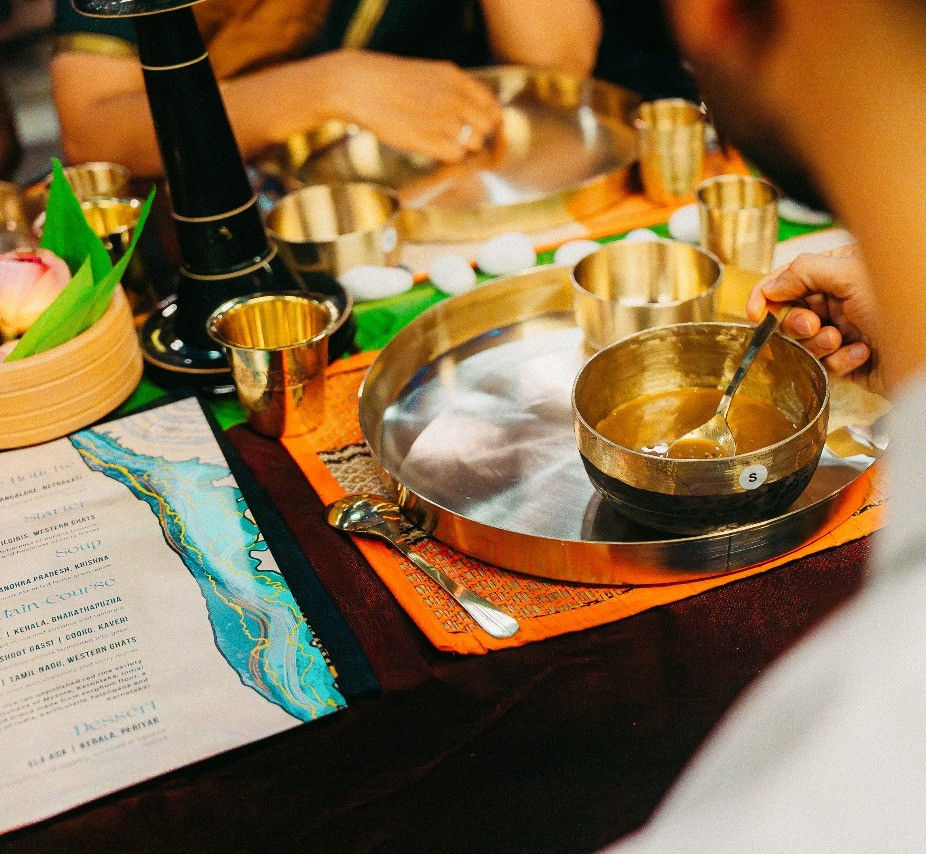
This reflection took form in Pravaha, the September edition of The Story Table — our series of intimate, immersive dining experiences where food meets narrative, performance, and conversation. Each edition of The Story Table explores a theme through taste, texture, and story, turning the act of dining into a shared act of discovery. Pravaha (meaning “flow”) was both a meal and a meditation — a reimagining of rivers as living archives of who we are, not just bodies of water that run through our maps.

“Each ingredient tells a story of rivers, soil, and seasons — reminding us that what we eat flows from nature, and ultimately returns to it. Food and ecology are inseparable,” says Deepthi Tanikella, founder of Pinch of South.
The Pravaha thali flowed like a river itself, each course tracing the journey of water through the Western Ghats and beyond. It began along the Netravati, with a crisp Pathrode Canapé, echoing the taro-leaf rolls of the monsoon coast. From the Nilgiris, there was Vazhaipoo Vadai, a fritter of foraged banana blossoms that spoke of the inventiveness of the hills. The Netravati estuary offered Marwai Sukka Tartlets filled with clams and coconut-chilli masala, while the Periyar’s backwaters brought the rich, peppery comfort of Duck Mappas, followed by the sweetness of Ela Ada — rice parcels steamed in banana leaves. Each bite carried the rhythm of a river basin, each flavour mapping a different landscape.
Around the table, conversation flowed as freely as the meal. Strangers lingered over seconds, swapped stories, and left with new names and numbers.
“Pravaha brought the rivers of the Western Ghats to the table — through food, stories, and shared moments, strangers became companions in celebrating and understanding nature,” Deepthi reflects.
To understand our backyard, perhaps we must begin by tracing the origins of what we eat — by noticing how soil, season, and water converge to make nourishment possible. In a world dulled by digital noise and distance, food remains one of the most visceral ways to reawaken our senses. When we eat with awareness, we begin to see the world not as separate parts but as a living system. And maybe, just maybe, that’s how we begin to care — one plate, one season, one flow at a time.


Comments