Kakkada's Secret: The Medicinal Leaf of Coorg
- Deepthi Tanikella
- Aug 13, 2025
- 4 min read

Updated: Aug 14, 2025

The earliest memory I have of Kshirabdi Dwadasi, a festival celebrated in my home, is of a clay pot holding the Osirikai chettu (Amla tree) and the Tulasi chettu (Tulasi plant) together. We prayed to it, and my mother told me many stories around it, religious ones, yes, but what pulled my heart most was the worship of the trees.
She knew I was too young to grasp theology, so she explained it through the natural world. In winter, she said, the amla fruit is essential for the body. The neem is a natural protector. She never told me, "Just worship them." Instead, she told me why, and that "why" is what stayed. I appreciate it when adults take the time to convey the truth about plants, trees, and the earth to children, rather than merely focusing on rituals.
I’ve sensed this kind of ancestral wisdom in Coorg, my second home, a jewel of the Western Ghats. Long before I visited, I’d watched countless documentaries about trees, their worship, and the underground mycelium networks connecting them across the planet. Even the Avatar movie seemed to echo what I’d always felt, that trees are more than wood and leaves; they are living, sentient beings.

When I first stepped into Coorg, we were welcomed by a land where trees had stood for over 800 years: a rudraksh tree, a nutmeg tree, and vines older than memory. Despite appearing motionless, they continued to breathe, vigilantly guarding the land for centuries. For someone like me, who grew up in the city with an invisible void, the experience felt like coming home, not in a romantic sense, but in the way climbing a guava tree or plucking a mango used to nourish us, physically and quietly, in the soul.
Then I heard about the Devarakadus. These sacred groves are protected forests, rooted in ancient wisdom and tradition. Our ancestors understood the value of an untouched forest long before 'conservation' became a word.
To me, the Devarakadu is not just a forest left untouched. It is evidence that our ancestors were protectors of the future, not just keepers of the past. When they said, “This land cannot be touched,” they weren’t just preserving tradition. They were preserving life itself.
As journalist Susheela Nair writes in Deccan Herald,
“According to the ‘Aranyani Neethi’, or forest ethics, even a dry twig or a dead leaf from these groves cannot be taken out.”
The reverence goes beyond ritual. It’s a daily code of conduct, one that has silently kept these groves alive for centuries.
In Coorg, I saw how the land gives back when respected. I walked into the forest and found fresh, green cardamom pods, untouched by pesticides; their sweetness was unlike that of the dried ones in the market. I learnt about wild honey gathering, how the bees are never harmed, how prayers are offered before a single drop is taken, and how its flavour changes with the trees and seasons. I saw streams where fishing is forbidden because the fish are considered sacred, just like the groves.
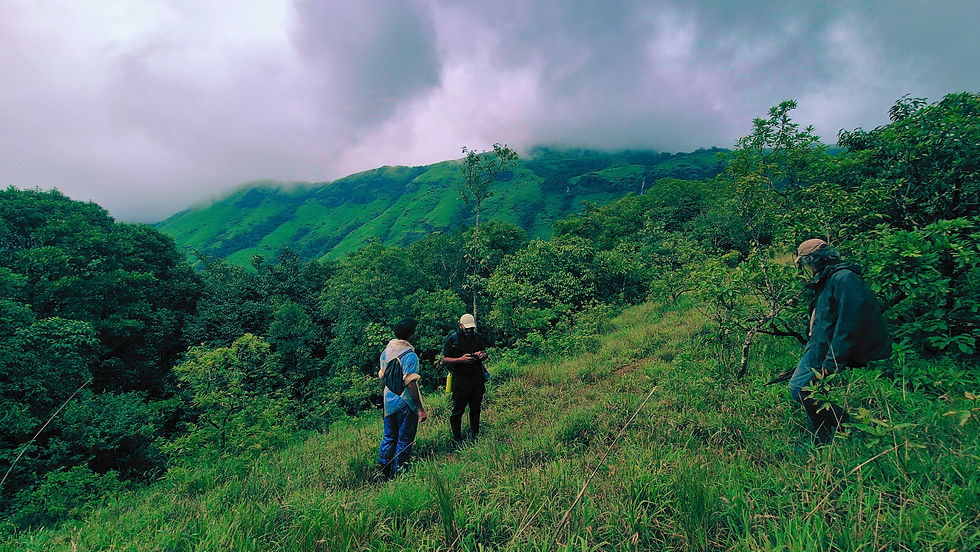
Here, everything eaten is either grown in the backyard or foraged from the forest. Standing in the forest, for someone who once plucked mangoes from a branch but now buys them on a quick-delivery app, was not an eye-opener but rather a reminder. A deep, old knowing that the forest feeds us in more ways than we think.
And that brings me to a taste of this one particular leaf that I had never heard of. When the hidden leaf appears before you, it signifies that you have received the forest's permission to exist. It was the first time I had tasted Maddu Payasa (sweet porridge) made from Maddu Thoppu (medicine leaf), scientifically known as Justicia wynaadensis. I remember the stories my friends told me when I was about to savour a spoonful of this payasa. My friends warned me to expect something extraordinary, and they were right.
Maddu Thoppu – The Monsoon’s Indigo Gift
In the wet, dark months of the Coorg monsoon, when the earth is soaked and the air hums with rain, an unassuming plant begins its brief season of wonder. Known locally as maddu thoppu, literally, “medicine leaf” (Justicia wynaadensis), it grows wild in the moist, shaded corners of the land, unnoticed for most of the year.
However, between mid-July and mid-August, during the most intense rains, a period known as kakkada, the maddu thoppu undergoes a transformation. Its stems and leaves, when boiled for an hour or two in plenty of fresh water, release a deep, peculiar fragrance that is medicinal, earthy, and unmistakable. The water shifts in colour, from a soft magenta to a deep violet and, at its richest, a luminous indigo. The Kodavas believe that the deeper the colour, the stronger its medicinal power.

The extract, prized for its warming qualities in the damp chill of the monsoon, is folded into beloved seasonal dishes. Maddu kuul is the simplest: consisting of rice cooked in indigo liquid, served warm. For something sweeter, there’s maddu payasa, a silky rice pudding, or maddu puttu, an unsweetened rice cake eaten with ghee and honey or a dark, molten jaggery syrup.
The plant cannot be cultivated at will; it must be foraged. And it appears only in these weeks of unending rain, making it a fleeting treasure in the Kodava kitchen. When the pot of boiling maddu thoppu fills the house with its strange scent and the water in it changes as the sky deepens to a coveted shade of indigo, this transformation signifies that the monsoon has reached its peak. The land is quietly offering one of its most beautiful, ephemeral gifts.


Comments